Blue Hill Books is a Little Free Library™ in Pleasant Grove, Utah

Tuesday, April 11, 2017

Charlotte Bronte's Jane Eyre

This may be my favorite novel of all. I don't think of it as gothic or overly melodramatic, as it is usually characterized these days. It's symbolic of real life to me. I have read it many times and love it more each time. I just love Jane, who I think is really the author, Charlotte Bronte (1816-1855), or who Charlotte knew was the right person to be. I love the words, I love the tone, I love the sentiment, I love the humility, I love the humanness, I love the faith, I love the strength, I love the good in this book. Characters, story, time period, writing, I love it all. I love it from the first nuanced line, “There was no possibility of taking a walk that day.”. . . to the very last three words in the book: “Come Lord Jesus.”

To begin with, we have Jane, the plainest name, symbolic of everyman (or everywoman). We have Eyre, similar to the word error. Charlotte read Dickens and Trollope and perhaps noted their meaningful name choices for their characters. I think she also chose her character names for good reason. Jane Eyre is about our frail, erring, but striving human nature, being meek and lowly and true and grateful and real and submissive to God, come what may. She tries to be longsuffering, sacrificing, forgiving, loving, in fact charitable in all the most important, Christ-like ways. And yet she is still led into error just as we all are. Edward Fairfax Rochester? Fair facts? As in truth, good and evil, right and wrong, God.
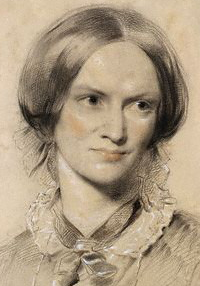
Image result for charlotte bronteI always have a point in the book when I doubt Rochester, which I suppose Charlotte means us to do. He comes across as such a heartless flirt. But then as the story goes on we become more charitable, as in more patient and understanding of this abused, wildly passionate, deep, brooding, suffering man, and we, like Jane, begin to pity him to our heart’s core. His nobility wins out in the intense heat of great trial, and we see he is all that Jane percieved he was underneath his rough, casual exterior.

The crux of this story is that this meek young intelligent person who was slighted and treated cruelly and unjustly for several years  of her young life, who finally found a home and love and purpose and interest and joy, gave it all up –everything– in her own intense heat of great trial; and she gave it all up for truth, righteousness, God. It's a fiction, yes, and overdramatic, people say. But such temptations and dilemmas and the principles and choices behind them are very real and applicable to anyone's life, always have been, always will be.

Very few people in this world today would even imagine this kind of sacrifice. To give up everything for God? To walk—no, run—away from every earthly connection, comfort, convenience, sustenance, position, institution, livelihood, human affection, human belonging, human desire— because of the undeniable existence of rightness? And yet she did that. Come what may. Even though she was innocent when it came to wanting to marry Rochester, she admits she erred in idolizing him.  Would she stay with a man she loved, even wrongly idolized, who she suddenly learned was technically married, legally and morally tethered to another woman? No, she would not, not for any other reason than it was wrong in the sight of God and man. There I plant my foot, she said, and besides walking away from the outward evil she also learned to relinquish the false idol in her heart. Isn't this what God requires of us?

Today most people do the exact opposite: compromise, rationalize, essentially abandon God and truth and righteousness to keep hold of every earthly connection, comfort, convenience, sustenance, position, institution, livelihood, human tie, human belonging, human desire. We see this in the concessions people make, in the lies people invent, in the games people play, in the “rights” people demand, in the money and positions people go after, in the evils people propagate, in short, in the defining lusts of our times. 

I never tire of reading and learning about the remarkable Bronte family. I’m so grateful to my husband Stephen for driving me on that wild goose chase through the winding hills and vales of  the English countryside to find Charlotte Bronte’s home on a business trip to England. Several times I suggested we give up the search. But he wouldn’t have it. We arrived just minutes before the museum was to close, and the nice lady let us in. It was like stepping back in time. Haworth probably hasn't changed much since Charlotte's time. I remember the calm, sad, enduring feel of the parsonage house, the Bronte children’s tiny handmade, handwritten books, Charlotte’s tiny-waisted dress and ancient, slim, thin-fingered gloves, like a fairy’s, like a spirit's.

Some quotes:

Helen Burns: “Hush, Jane! You think too much of the love of human beings; you are too impulsive, too vehement; the sovereign hand that created your frame, and put life into it, has provided you with other resources than your feeble self, or than creatures feeble as you. Besides this earth, and besides the race of men, there is an invisible world , and a kingdom of spirits: that world is round us, for it is everywhere; and those spirits watch us, for they are commissioned to guard us; and if we were dying in pain and shame, if scorn smote us on all sides, and hatred crushed us, angels see our tortures, and recognise our innocence (if innocent we be . . . ), and God waits only the separation of spirit from flesh to crown us with a full reward. Why, then, should we ever sink overwhelmed with distress, when life is so soon over, and death so certain an entrance to happiness . . . ?”

Jane: “Distrust it, sir; it is not a true angel.”

Janie: “That sounds a dangerous maxim, sir; because one can see at once that it is liable to abuse.’

“Sir,” I answered., “a wanderer’s repose or a sinner’s reformation should never depend on a fellow- creature. Men and women die; philosophers falter in wisdom, and Christians in goodness: if any one you know has suffered and erred, let him look higher than his equals for strength to amend and solace to heal.” 

Jane:“Laws and principles are not for the times when there is no temptation: they are for such moments as this, when body and soul rise in mutiny against their [the laws and principles] rigour; stringent are they, inviolate they shall be. If at my individual convenience I break them, what would be their worth? They have a worth–so I have always believed; and if I cannot believe it now, ti is because I am insane–quite insane: with my veins running fire, and my heart beating faster than I can count its throbs. Preconceived opinions, foregone determinations, are all I have at this hour to stand by: there I plant my foot.
    I did.”

Me: The above passage is hardly understood today, either that or it is twisted to support the popular sophistries. Now those inviolate certainties, laws, principles, opinions, determinations, she is referring to here are gone from us. Our moral foundation is ground to dust. How do people choose the right when there is no right held up to be seen, when they haven’t been taught it, when evil principles, laws, opinions, determinations  have replaced righteous ones? This development probably never even crossed her mind.

Jane: “It is hard work to control the workings of inclination and turn the bent of nature; but that it may be done, I know from experience. God has given us, in a measure, the power to make our own fate; and when our energies seem to demand a sustenance they cannot get–when our will strains after a path we may not follow–we need neither starve from inanition, nor stand still in despair: we have but to seek another nourishment for the mind, as strong as the forbidden food it longed to taste–and perhaps purer; and to hew out for the adventurous foot a road as direct and broad as the one Fortune has blocked up against us, if rougher than it.”

St. John: “Amen; even so come, Lord Jesus.” 

Janice Graham


P.S. And I love her other three novels too.


Sunday, October 2, 2016

My New England "LiteraTOUR"

Well, we did it! Husband Steve and I took our little Tab trailer, bikes, and two-seater kayak across the country and found the roots of some of my favorite American authors I've been reading lately in my Lifetime Reading Plan. We went almost 7,000 miles in 3 weeks. The leaves were just changing and the weather was balmy (although a bit unseasonably warm and humid at times. Luckily we have AC in the Tab).

When we got home one of my first thoughts was of my Little Free Library and how to share my  experiences. So I decided to use my book bin to highlight treasures from my New England "litera-tour." (Don't I have a nice husband to take me on wild-goose chases while listening to me read aloud and rave on? He did this for me when we spent some time in England, too, which I should write about later.)

This was a long-dreamed-about trip, but actually came to be on the spur of the moment. We decided to do it only two days before we left. This was because we had to get to the Value Voters Summit in Washington D. C. in five days. Our daughter and her family live near there and we always fly and stay with her for this conference which we have attended every year since it started 11 years ago. At the last minute we decided to combine everything into one road trip.

Beyond getting to Maryland to our daughter's house our plans were not concrete. It was more like me saying, Hey, do you think we can go to Orchard House or Walden Pond? And my husband saying, Sure! It ended up being more than I ever dreamed.

The conference was very good (Matt Walsh had me at C.S. Lewis), we took in Shenendoah's gorgeous Skyline Drive one day with our family, and then said goodbye and headed north-ish. (We saw a lot on this trip, as in Niagara Falls, but for the purpose of this post I will highlight the author sites.) Pulling into the Minuteman campground near Concord, Massachusettes, hidden in a beautiful forest of tall trees, we unhooked the Tab and headed for perhaps the most author-dense pinprick in the nation.
First up, Orchard House, plain and brown, where Louisa May Alcott lived and where she based Little Women. We enjoyed a nice tour of the house which included a lot about U.S. history and Louisa's family and life. Little Women came to life. I must read it again keeping in mind how autobiographical it really is. We stayed a couple hours and then took to our bikes on the nearby Minuteman trail for several miles. Next, the Old Manse, across the street from Orchard House, so named by Nathaniel Hawthorne, whose book Mosses From an Old Manse I had read less than a year ago and so loved. This creaky 300-year-old house once belonged to Ralph Waldo Emerson, whose glorious writings I also read recently, who invited Hawthorne to stay. I was invited to play a few bars on the parlor grand piano and saw these great writers' rooms and views from their windows, even love-poem etchings on the window glass done by Hawthorne's wife with her diamond ring. I soaked in as much as I could of the times and souls and thoughts that had passed through that house. We didn't have time to tour Wayside House nearby, where Alcott, Hawthorne, and a little later, Margaret Sidney (who wrote The Five Little Peppers series) lived. But we weren't done with Concord yet.

September 19 dawned very muggy and wet, the very day we planned to visit Thoreau's Walden Pond. I had read Walden not long ago and found it spiritual and moral and uplifting, perhaps contrary to the purely granola way it is represented today. Ever since I read it I have tried, as Thoreau advised, to appreciate the sunrise/sunset as one thing that can be relied upon to help keep hold of one's sanity. I also use wonderful quotes from him on my Blue Hill Books bookmarks. "We should treat our minds, that is, ourselves, as innocent and ingenuous children, whose guardians we are, and be careful what objects and what subjects we thrust on their attention." And "Books, the oldest and the best, stand naturally and rightfully on the shelves of every cottage."

Thoreau being in a state of mourning at the death of his brother, Emerson offered his land as a retreat. Thoreau decided to build a tiny cabin, write, and live off the land, which he did for two years. The original cabin is long gone, but a charming facsimile has been constructed, as per his detailed description in Walden. And rain or not, after we delightedly learned that the pond (part of the state park) is available for recreational use, we went to the pond (which is more like a lake) and launched the kayak. Even in the rain the verdant, isolated place felt blessedly serene. We had it practically all to ourselves except for a few intrepid swimmers. After rowing its circumference, I decided to
take a swim myself. The rain had abated, the air was warm, the water was only a bit cool, and I swam the half mile across with Steve rowing the kayak alongside. See what I mean about better than I ever dreamed? Can soaking up the atmosphere of the place get any better than swimming in quiet soft glassy cool Walden Pond?

Due to intermittent tour hours we missed seeing the inside of the stately white Emerson house, where he also lived, but walked around the charming gardens. Next was Concord Museum where we saw Thoreau's green desk and so many other interesting things that we were late checking out of our campground and had to pay a late fee!

On to Hartford, Connecticut. We had been to Hannibal, Missouri, Mark Twain's childhood home, years before, but since viewing Ken Burns's wonderful documentary, I really wanted to see the big fancy house Samuel Clemens built for himself and his beloved family when he finally settled down.
Set downtown on a bit of a hill, surrounded by towering leafy trees, what a dark house it is, a man's house I'd say, with dark walls, dark floors, dark furnishings, dark staircases, dark carved embellishments and, among some white marble sculptures, even dark works of art. They had the lighting set as if gas-lit as per the times, and I felt I was going a bit blind. Even the children's schoolroom was dark and full of dark furniture, toys, and books. The children's bedrooms were lighter and sunnier. (Sorry, no photos were allowed inside.)
Twain's third-floor man-cave fit him to a T, with its billiard table and masculine writing desk and accoutrements. His happiest family times and most productive writing took place in this house. But I felt its darkness was an omen of the sadness that was to come. He failed financially because of speculations in a printing machine, had to leave the house, worked hard to make back his fortune by lecturing around the world, and outlived his cherished wife and all but one of his four beloved children. The museum next door was the biggest, fanciest museum I've ever seen built for one man. Did you know that in his time he was the most famous American on earth? I have a goal to read everything he wrote. So far I've read and reread: Tom, Huck, Joan, Yankee, Prince, Pudd'nhead, and some stories. Innocents Abroad, here I come.

Next door was none other than Harriet Beecher Stowe's house. Here was the little woman who started the big war, as Lincoln put it, by writing Uncle Tom's Cabin. We were running out of time and did not take the house tour, but wandered the gardens a bit. At least we had visited the Harriet Tubman house just days before in Auburn, New York--what a great tour and lecture they have there.

My husband made a valiant effort to get us to Sunnyside House, the home of Washington Irving in Tarrytown, New York, but when we finally got there a scary woman in the back of a truck loading up garden refuse warned us off. It was closed on Wednesdays! I think I'll read The Legend of Sleepy Hollow again anyway. Somehow it fits.

So there's our New England Literatour.  I've stuffed my special book bin in my little library with books from these great authors. As soon as we got home I read a thin volume of Louisa May Alcott's short stories. What beautiful writing and how firm her foundation in goodness. Remember, what we read matters. Be careful what you feed your mind!

Books are the best of things, well used: abused, among the worst. Ralph Waldo Emerson.


Wednesday, May 4, 2016

Great Tales of Ships, Seas, and Islands

Ahoy mates! I have had a little lending library breakthrough! I like to have special collections in my library but it takes a while to collect up enough books on a certain theme to fill it up. So . . . I thought of having a book bin inside the library that contains the collection (it fits up to 15-20 books) while the rest of the box is stuffed full with all sorts of other good books. It's much more doable and offers more variety. Yay!

My new collection is one that I have been excitedly working on:  great books about ships, seas, and islands. Here are my titles on hand, all great reads:

The Odyssey
Gulliver's Travels
Robinson Crusoe
The Voyage of the Beagle
Treasure Island
The Old Man and the Sea
Island of the Blue Dolphins
Billy Budd
Moby Dick
Lord of the Flies
The Swiss Family Robinson
The Voyage of the Dawn Treader
The Sea Wolf
Life of Pi
A Night to Remember
Mutiny on the Bounty
The Borrowers Afloat
The Cay

That's all I can squeeze into my bin for now. Meanwhile I am scanning my local thrift stores for copies to lend of these additional favorites:
A High Wind in Jamaica
Blue Skin of the Sea
The Island of the Colorblind

On my personal want-to-read list are:
Master and Commander
Horatio Hornblower
Two Years Before the Mast

Summer is a great time to weigh that anchor and set sail, bookwise!

Wednesday, March 9, 2016

The Mind Eclectic

It seemed like a good time to again take inventory of the books on my night stand (that is, the books I’m currently in the middle of reading). I had to laugh. This could be one of the most multifarious assortments of books for one person to be reading at the same time ever.

Voyage of the Beagle by Charles Darwin
Ramona and Her Father by Beverly Cleary
Obedience to Authority by Stanley Milgram
Cards on the Table by Agatha Christie
Ivanhoe by Sir Walter Scott
The Birds and Other Stories by Daphne Du Maurier


I mean! Could any stack of books be more unlike?

The Voyage of the Beagle is for Classics Club. So far I am pleasantly surprised, although it doesn’t seem to hurt to do some skimming. It’s essentially a travelogue of an early nineteenth century South American sea voyage by an enthusiastic amateur naturalist who colorfully describes everything from the cowboy Gaucho life to octopi to rocky salt caches. I am keeping my humongous atlas and magnifying glass handy so I can see where he is and pick up a little much-needed geography knowledge on this voyage. (Next is Darwin’s On the Origin of Species which I am not real excited about—much as many people insist on still taking his theory as fact, it’s been disproved by the lack of evidence in our now vast fossil record, new technology-based proofs disputing the notion of  a magma-centered earth and deep time, and the discovery of DNA, to name just a few of the many problems. I think Darwin's theory has been and is still used pretty much as an excuse not to believe in God, and yet you need great amounts of blind faith these days to believe in the debunked theory of evolution!)

My kids, grandkids, and I are reading Cleary books this year so I’m starting with the Ramonas. Very funny and cute so far.

The other day I watched the docu-movie Experimenters on Netflix. It was so fascinating I immediately ordered Milgram’s book, Obedience to Authority, which is also fascinating and fits right in with my views. His post-WWII study, although I believe shockingly unethical (no pun intended--they use electric shocks) showed that yes indeed, man is fallen, prone to do the wrong thing, morally lazy, eager to sluff off responsibility for moral and religious beliefs onto any sort of authority-type-looking or acting figure. Sad but true. We have to admit this fact or we won’t strive to overcome it.

With all this assigned and technical reading, I have to read some Agatha Christie. I recently discovered her for myself and can't get enough. She’s always good for some mentally stimulating R&R. And I like anything by Du Maurier. By the way, the short story "The Birds" is way better than the Hitchcock film made from it ( and I usually love Hitchcock movies).

Okay, I have to admit I am stagnated somewhere about a third of the way through Ivanhoe. But I’m determined to finish it just because I'm sorry I've never read it, so there it sits in prime real estate on my night stand.

Oh but there's more. Underneath the above, are two bright green books. One is the biography of Flannery O’Connor by Brad Gooch I’ve been wanting to read. (I've read all of Flannery's stories over and over.) The other is The Sweetness at the Bottom of the Pie by Alan Bradley recommended by one of my daughters.

Am I lucky or what? Who could ask for a more varied, interesting, and active internal intellectual life?


Tuesday, March 1, 2016

The Year for Cleary

Guess what? Beverly Cleary is turning 100 years old this year on April 12! Let’s read her books!

I missed out on Cleary books as a child. I have a few theories as to why this happened. Her first book, Henry Huggins was published in 1955, a year after I was born, so her books were still quite new when I was a young reader but not so new that I wouldn’t have seen them at the library or had them read to me by my very bookish elementary school teachers. Yes, my teachers, especially my third and fifth grade teachers, read lots of books aloud to us, but no Cleary that I can recall. Believe it or not, in the early 60s her books were considered too radical. Were they? Are they still?

I think one reason I didn’t pick Beverly Cleary off the library shelf was that I always turned my nose up at a book that looked as if it were going to be about boring regular life. No, I didn’t read the Little House books or even Nancy Drew. And I didn’t play with Barbie; I played with those little troll dolls with the colored hair that sticks straight up. I discovered that I liked the magical toys and the magical books, such as those by E. Nesbit and Edward Eager and E. B. White, what I came to think of as those magic E authors.

I first read Cleary as an adult when I had reading children of my own and was writing articles and stories for children’s magazines. I think the first one I read was Dear Mr. Henshaw, which won the Newbery award. The first half is laugh-out-loud funny. Humor is definitely her forte. But then it goes oh-so-dark. There are some problems with it, which I have written about on this blog. After that I tried the Ramona books and they hit the spot and probably influenced some of my own magazine stories. I still remember the trouble she had with her owl art project and the time a dog took her shoe on the way to school so she made one out of paper towels from the school rest room. Ha-ha! 


No, my teachers did not read Cleary books to me. They had not yet stood the test of time. Let’s find out if they do, and which ones, a half century later. I’m going to start with the eight Ramona books for girls and then the Henry Huggins for boys, then, if I feel they are worthy classics, put them in my little library in April to celebrate Beverly’s 100th birthday. Clearly, I better get reading Cleary!
   
Here’s a handy booklist to get us started. By the way, I went to the local thrift store and easily found six Cleary books I didn't already have for 75 cents each.

    Henry Huggins, Morrow, 1950 †
    Ellen Tebbits, Morrow, 1951
    Henry and Beezus, Morrow, 1952 †
    Otis Spofford Morrow, 1953
    Henry and Ribsy, Morrow, 1954 †
    Beezus and Ramona, Morrow, 1955 ‡
    Fifteen, Morrow, 1956
    Henry and the Paper Route. Morrow, 1957 †
    The Luckiest Girl, Morrow, 1958
    Jean and Johnny, Morrow, 1959
    The Hullabaloo ABC, Parnassus, 1960
    The Real Hole, Morrow, 1960
    Beaver and Wally, Berkley, 1960
    Here's Beaver!, Berkley, 1961
    Two Dog Biscuits, Morrow, 1961
    Emily's Runaway Imagination, Morrow, 1961
    Henry and the Clubhouse, Morrow, 1962 †
    Sister of the Bride, Morrow, 1963
    Ribsy, Morrow, 1964 †
    The Mouse and the Motorcycle, Morrow, 1965
    The Growing-Up Feet, Morrow, 1967
    Mitch and Amy, Morrow, 1967
    Ramona the Pest, Morrow, 1968 ‡
    Runaway Ralph, Morrow, 1970
    Socks, Morrow, 1973
    Ramona the Brave, Morrow, 1975 ‡
    Ramona and Her Father, Morrow, 1977 ‡
    Ramona and Her Mother, Morrow, 1979 ‡
    Ramona Quimby, Age 8, Morrow, 1981 ‡
    Ralph S. Mouse, Morrow, 1982
    Dear Mr. Henshaw, Morrow, 1983
    Ramona Forever, Morrow, 1984 ‡
    The Ramona Quimby Diary, Morrow, 1984
    Lucky Chuck, Morrow, 1984
    Janet's Thingamajigs, Morrow, 1987
    A Girl from Yamhill, Morrow, 1988
    Muggie Maggie, Morrow, 1990
    Strider, Morrow, 1991
    Petey's Bedtime Story, Morrow, 1993'Bold text'
    My Own Two Feet, Morrow, 1995
    Ramona's World, Morrow, 1999 ‡
    Two Times the Fun (omnibus containing The Real Hole, Two Dog Biscuits, The Growing-Up Feet, and Janet's Thingamajigs), Morrow, 2005

Postscript: I have now read all eight Ramona books. So funny, real, and good. Ramona the Brave is my fave. The three Mouse books are cute, too.

Monday, December 28, 2015

Dickens in Heaven

We got the big snow this December and a thoroughly white Christmas. But not many visitors to my little library. It is difficult to find time to read in such a busy month. I was lucky to sneak in my annual Dickens at the last minute. I only had 10 days or so, so I chose the unfinished 200-page
The Mystery of Edwin Drood and absolutely loved it. Then I watched the 2012 2-episode BBC version, and although they left out a few of the great characters I thought their last-minute twists and ending quite acceptably Dickensian. I appreciate them giving this great book a good ending, although in the introduction to my edition G.K. Chesterton said, "What was the mystery of Edwin Drood from Dickens's point of view we shall never know, except perhaps from Dickens in heaven, and then he will very likely have forgotten." Yes, I think that is true of him. I think when we get to heaven, those of us who want to get there (Chesterton and Dickens seemed to want to), we won't be at all about any earthly accomplishments and legacies, just as those were not our focus here on earth. But Dickens's God-given delightful talent and insights into human nature, good and evil, are certainly gifts to us here and now to help us on our way.

Chesterton goes on to discuss the several different scholars' theories concerning the end of this unfinished story, which all sounded stretched to me. Like I said, I liked the BBC ending quite well. Still, as Chesterton wrote, "Dickens is dead, and a number of splendid scenes and startling adventures have died with him. Even if we get the right solution we shall not know that it is right. The tale might have been, and yet it has not been. And I think there is no thought so much calculated to make one doubt death itself, to feel that sublime doubt which has created all religion---the doubt that found death incredible. Edwin Drood may or may not have really died; but surely Dickens did not really die. Surely our real detective liveth and shall appear in the latter days of the earth. For a finished tale may give a man immortality in the light and literary sense; but an unfinished tale suggests another immortality, more necessary and more strange."

Yes, I truly believe in heaven, too. I once wondered if I'd get to meet my favorite authors in heaven . . . Dickens, Charlotte Bronte, C. S. Lewis, Flannery O' Connor. But on second thought I decided I better let that presumption go. As Lewis writes in The Great Divorce, if we want something other than God and His gifts, we won't even choose to go there, we will choose the other place! And heaven is where I want to go. Once there, if I see them, I see them. If I don't, I don't. And if I do get to meet them, I imagine there will be even bigger and better things to talk about than the books they wrote, perhaps the exciting ideas and principles contained or hinted at within the books they wrote. Won't there be only large minds in heaven, the kind that talk about ideas rather than people and things and events?


Now I can put this book in my little library current collection: Books with Character Names for or in the Titles. (I never put anything in my library that I haven't read.) How many such books can you name off the top of your head? There are more than you may think. My little library filled up fast just from my stock here at home.

Tuesday, October 13, 2015

Bookworm or Creative Reader? Ask Emerson.

In Classics Club (readings from a huge book list/guide from Homer to Solzhenitsyn, The Lifetime Reading Plan) we write letters to each other about the books. Here's my Classics Club letter on Selected Writings, Ralph Waldo Emerson (1803-1882).

September 1, 2015

Dear Active Souls,

"Books are the best of things, well used; abused, among the worst."

Yes, that’s Emerson, said to be the most quotable epigramist (definition of epigram: quip) in the English language. As I read, I certainly saw this. I underlined lots of his short, astute, quotable quips. I also saw why Emerson’s influence over us has declined. For all his individualism and Americanism and pushing of the envelope and reformer reputation, he’s undeniably and traditionally religious. Without reading him I grew up thinking he was at bit off—"transcendentalist" and all. He does tend to exaggerate and go too far, off into the ether, sometimes. I can see why he was a leader, albeit not of a church, and people glommed onto him. What a way with words!

For the most part, I was pleased to find that he hits morality, the presence of absolutes, and God right on the button. I will read him again.

I had a bit of difficulty finding the suggested selected writings in The Lifetime Reading Plan all in one place. I started out reading this and that here and there and then liked him so much I wanted one volume I could underline and make notes in. Couldn’t find anything I wanted online so Steve and I made a maiden voyage to the new location for Pioneer Book in Provo. They have really fixed up their musty old used book store. It’s all the rage to place books on shelves in rows according to colors, which is fun to look at but doesn’t make much sense otherwise. They have shelves like that in the front window, blues and reds and whites, and the monstrous main check-out desk is actually made of miscellaneous stacked books which is great. There are nice leather chairs and tables in hidden little reading corners and lots of space on two levels. I was pleased to find a very quaint, old (no date) volume of Emerson for $7.95, hardback, unmarked, smallish, red fabric cover, with a little gold embossed Ralph Waldo Emerson front and center and fleur-de-lis on the binding. Perfect. Most everything was there out of the eight writings suggested. The only things I didn’t read are his essay on Thoreau and English Traits, which I may search out online some time. So I read Nature, The American Scholar, and essays History, Self-Reliance, on Plato, Goethe, and Montaigne. I enjoyed them all very much. He understood the important things. I liked his original-sounding thoughts on the responsibility of self, truth, traveling, writing, prayer, good and evil, God, and childhood.

I thought this idea, relative to the pervasive technology of today was prophetic: "The arts and inventions of each period are only its costume, and do not invigorate men. The harm of the improved machinery may compensate its good."

More tidbits:
"Men imagine that they communicate their virtue or vice only by overt actions, and do not see that virtue or vice emit a breath every moment."

"The one thing in the world of value is the active soul . . . the soul active sees absolute truth and utters truth, or creates . . . In this action is . . . the sound estate of every man." Isn’t our soul the only thing we can take with us?

My little slogan for my little library, Blue Hill Books, is “What we read matters.” I think Emerson would approve. He talks about books being unthinkingly read just because they exist, "Hence, instead of Man Thinking we have the bookworm . . . hence the bibliomanics of all degrees." Sorry to say, this is what happened with Oprah’s bookclub. Yes, she got people reading like crazy, but what and why? Most of the popular literature of today is worthless and nihilistic, I’m afraid. And what does have worth is made over to justify and shore up our unthinking times. Emerson was right: There is creative reading as well as creative writing.

Here is a great one: "Let [man] learn that he is here, not to work, but to be worked upon . . ."

I found a lovely quote for my current writing project, I Learned to Swim in the Ocean, which I may never finish. I want it to be short but I keep adding to it from all these great readings. I often think of my childhood, and am so grateful to my parents for making it such an innocent, secure, and precious time full of experiences and memories I keep learning from: 

Emerson: "The actions and events of our childhood and youth are now matters of calmest observation. They lie like fair pictures in the air."

Thanks Mom and Dad,

Janice